29 September 2010

Damaged Tape - 2010 - Beyond the Astral Labyrinth

These electronic tunes had a nice, long gestation period, and I'm pretty happy with the final results. I wanted to get away from the 'four-on-the-floor' house sort of beats that I used a lot on Psychedelic Anthropology and focus more on the 'sonic sculpture' concept that I had back with Electric Ocean. Of course, with a completely different set of instruments and recording equipment, this music is hopefully its own entity. Although several of these tracks were quick and painless, several of these tracks (especially the instrumental ones) were originally intended to be part of a collaboration and intentionally left half-finished. But after more than a year and a few shifts in perspective, I finished them up mostly with the help of my Juno 60 synthesizer.

The concept for this album originally involved Scott's (the other feller in Damaged Tape) exploration of Japan's Izu peninsula. Unfortunately, I didn't necessarily get around to finishing all the tracks that involved those ideas, plus the cover to Glaze of Cathexis' The Golden Konbanwa already sort of got that idea down visually. This means that Scott is far better equipped to talk about the conceptual nature of these recordings. Here's what he has to say:

Inspiration for this spoken word came from free-associative thoughts in quiet times of
the night and day, and the only necessity was to just listen and be receptive to
our innate intuition.

Of this I feel-
delving into the collective subconscious is like descending into a deep well within a well,
accessing information from those shimmering purple-black waters reflecting
the glints of diamond-chip stars endlessly beyond. In this journey of metamorphosis
and transcendence, the wisdom and insight gained belongs to all, as this wisdom
and insight, shrouded in profound, sacred mystery, is an innate and inseparable part of us.

Anyway, I'd love to hear your comments concerning these songs (good or bad), and if you want to repost, please let me know! It always makes my day.

Track List:
1. Dimensions Untold Of (5:12)
2. Bamboo Hollow (4:08)
3. Amphibians of Time (4:03)
4. Lexicography of the Universe (2:41)
5. Crystal Forge (4:15)
6. Conflux of Reality (3:53)
7. Infinity's Quest (5:14)
8. Mind if the Vortex (2:28)
9. Endless Ocean (4:48)
10. A Desert of Cobalt (5:19)
11. The Cosmic Election (2:35)

Listen to Me:
Damaged Tape - 2010 - Beyond the Astral Labyrinth (full quality)
Damaged Tape - 2010 - Beyond the Astral Labyrinth (256kps)


Rust - 1969 - Come With Me

Quality: 4.25 out of 5
Trip-O-Meter: 4 out of 5

Although hailing from Germany, Rust definitely does not fit under the krautrock umbrella. This is full blown psychedelic garage rock in the vein of the Electric Prunes with a bit of British psychedelic production madness thrown in for good effect - it's very much in a 'summer of love' sort of mindset. I'd say early Traffic is another good comparison of the sounds found here. The performances are pretty top notch, but the real ace in the whole is the songwriting. Rust's tracks are extremely well written and pretty catchy overall. If these guys had been from the States or Britain two years earlier, I bet they would've become a major concern.

This album stays pretty strong throughout. My favorites include the west coast garage rock blasts of "You Thought You Has It Made" (complete with ridiculous vocals effects!) and "Delusion," while "Please Return" and the title track do the best job of going for that early Traffic vibe, and "Find A Hideaway" actually finds a very groovy balance between the Byrds, Love, and the Jefferson Airplane. It may be the best track here.

Despite the creepy, gothic, and somewhat terrible cover art, Come With Me is a pretty technicolour slab of psychedelic rock. Although it doesn't quite bat with the A-list, it certainly is undeserving of obscurity and plays better track-by-track than a typical album by the Electric Prunes or Chocolate Watchband (not to slight those still great bands).

Don Cherry - 1972 - Organic Music Society

Quality: 4.25 out of 5
Trip-O-Meter: 4.5 out of 5

Don Cherry was one of the more notable jazz trumpeters, often appearing as a collaborator or sideman to jazz greats like Ornette Coleman and John Coltrane in the late 1950's and 1960's. On this album as bandleader, Cherry guides the music into world music sounds on the first LP while working on the more avant-garde side of acoustic jazz on the second. You'll hear echoes of Sun Ra, Pharoah Sanders, and Albert Ayler among others on this album, but Cherry is still able to bring together a singular and fascinating vision of his own.

The opening track claims to be a northern Brazilian ceremonial hymn, but there are plenty of other world music hints here as well such as Indian drones and Tibetan percussion. The track is a slowly building chant which is supported by a growing percussion section and the 'ceremonial' claim of the title certainly comes across as accurate. "Elixir" gives us a full blast of tribal percussion framed by a flute solo and Indian-inspired violin (although the violin playing does comes across as a little scratchy). "Relativity" is a two part suite which unfortunately repeats the basic bass line of "Elixir," but does continue with awesome percussion and adds in some chanting that finds space between the contemporaneous chants of Pharoah Sanders and Sun Ra, and a bit of speaking in tongues.

You really don't hear a whole lot of Cherry's trumpet on the first LP, but the more jazz-oriented second disc features more of his playing (and I'm guessing that's him on the flute as well). For most of this disc, the band drifts in and out of several tunes, coming across as a group of far-out jazz cats having a 3am jam in an opium den. Although not quite free jazz, this music is very improvisational sounding, but in a very gentle and drifting way as opposed to the harsh, confrontational sound that 60's and 70's avant-garde jazz can often dish out. The closing track, "Resa," is separated from this motif. It sounds like a live recording (although a perfectly listenable one), and edges a touch in spots towards Albert Ayler's free jazz swoon.

This is a fine late night record for those of you interested in the trippier side of jazz. While not an absolute classic, there are some wonderful sonic colors to discover on this LP, and the cover art definitely puts a nice bow on this package.

10 September 2010

Khan - 1971 - Space Shanty

Quality: 4 out of 5
Trip-O-Meter: 4.25 out of 5

I've always let Steve Hillage be my primary constant for exploring the Canterbury scene, and the short lived band Khan is another very groovy step on his musical journey. This plays pretty much like a Steve Hillage solo album with Hillage handling the vast majority of the songwriting and most of the vocals. Of course I'd be remiss not to mention organist Dave Stewart, who also played with Hillage on the Arzachel album and never had any thing to do with the Eurythmics (that's a different guy). His organ playing is a perfect foil for Hillage's crystaline leads and he gets a few moments to shine on his own as well. The sound does recall a fair amount of Khan's jazzy prog peers, but I always appreciate Hillage's 'new age Jesus' vibe, and the production here is very crisp and meaty.

Truthfully, the band pretty much fits a comfortable jazz-rock groove and sits on it for most of the album. It all flows very well, but certainly doesn't come across as groundbreaking. Yeah, it sounds sort of like an early 70's Pink Floyd albums, but it has a more positive vibe than those titans of the album charts usually managed. Besides, Hillage's guitar playing makes Gilmour sound like an amateur (although a very passionate one), and Dave Stewart hit some precise organ runs that I don't recall hearing Rick Wright manage. I dig the vocal part of "Space Shanty," as it reminds me of Cheech and Chong's performance at the end of Up In Smoke. "Driving to Amsterdam" and "Hollow Stone" pretty much sound like the same Meddle outtake, but this is a band that you can pretty much just float downstream with anyway. I also dig the acoustic glaze that permeates "Stranded."

While this album gets a D- for originality, the quality of the performances, production, and songwriting make it worth a few listens. Steve Hillage fans especially need to check it out. You would probably be accurate by slapping a label on the front of this that says 'Generic Canterbury Album," but that's not necessarily a bad thing when you could end up with Grand Funk Railroad or the new Justin Beiber album instead.

Buy Me:
Khan - 1971 - Space Shanty

Arzachel - 1969 - Arzachel

Quality: 4 out of 4
Trip-O-Meter: 4 out of 4

This is an interesting early effort from the soon-to-be members of Egg and 70's space guitar diety, Steve Hillage. Apparently, the musicians more or less threw this together from only a day in the studio, but the musicianship is at such a high level that it comes out sounding far more thought out than its origins imply. They'd also been playing gigs together a year or so earlier under the name Uriel. Still, for a lark this is pretty solid stuff. The music here is right on the cusp between 60's psych and prog, infused with the vibes of the Canterbury scene.

The album begins with several shorter form tracks, the best of which is the opening "Garden of Earthly Delights." It comes across very much like one of Traffic's better psych singles and the balance between Mont Cambell's psych-folk crooner vocals and Steve Hillage's happy, but never quite on key, singing is fun. You also get a pure blast of Hillage's lead guitar work at the end, although you'll find plenty of that on this LP. "Azathoth" starts out sounding like a more gothic Procol Harem before becoming far more unsettling near the end. "Queen St. Gang" and "Leg" are the lesser tracks, with the former being a pleasant but unassuming psych-jazz rocker and the latter sounding like a Cream outtake, although Hillage's attempt to nail a Jack Bruce-style vocal doesn't really hit the mark. This causes the band to de-evolve into insane echoing feedback for the last few minutes of the song.

Side two brings us two, long jammy tracks. The first one, "Clean Innocent Fun," carries on the Cream vibe, but with lots of organ. It's a little derivative, but I'd honestly rather listen to Hillage rip out wild leads on his guitar than Clapton, and the band works up a proto-punk head of steam that Cream was never able to do. "Metempsychosis" is the better of the long form tracks, with the band serving up a sixteen minute psychedelic freakout that would have captivated the heads at the UFO Club in the 60's. Yeah, they recycle a few tricks from early Floyd and the Soft Machine, but I think that these top-notch musicians are able to pull it off a little better (not that the Soft Machine didn't have top-notch musicians too - and the Floyd charming ones). Along with the album opening, this is the one that you need to hear.

Here at the Psychedelic Garage, I often get distracted by ambient and krautrock tangents, but if you need a dose of straight up, pure psychedelic rock, this is a pretty good album to shove into your earhole. It's got a couple of great songs in its grooves, and plenty of full on attacks from one of the better psychedelic guitarists around.

09 September 2010

Vangelis - 1985 - Invisible Connections

Quality: 3.5 out of 5
Trip-O-Meter: 4.25 out of 5

Vangelis went through the 80's best known for his blaring fanfares and creating records that sank deeper and deeper into flashy new age. This collection, however, is extremely ambient and an entirely different creature. Do not come to this album expecting any of Vangelis' trademark melodicism. The sounds of the mostly digital synthesizers are very representative of 80's technology, but Vangelis manages to use these tools in a very tasteful way. I'd be lying though if I say I didn't miss the analog opulence of his 70's work.

While the first half is pretty abstract, the second half of "Invisible Connections" is exactly what you would expect to hear walking into a planetarium around 1987. I mean this as a compliment as I thought planetariums were awesome as an elementary school student at that time. There are plenty of lush pads layered into the track and there were at least five moments where I thought the music was about to shift into the opening music of "Star Trek: The Next Generation." This works for me as well since I still like watching that show. The second two tracks, "Atom Blaster" and "Thermo Vision" are more like a digital update of what Vangelis was doing on Beauborg. I don't like them as much as Beauborg, nor are they as groovy as the opening track. I guess when you're trying to create chaos, the binary 0's and 1's of a digital instrument simply don't work as well as analog unpredictability. Still, both tracks are fine as background music to slowly drive you pleasantly insane.

I don't think that this is quite up to the standard of Vangelis' 70's work, especially when compared to the like-minded Beauborg, but this album is worth a listen for fans of this synth master. The second half of the title track is definitely a great one - it's just too bad that Vangelis couldn't keep my attention fixed quite as well for the other three quarters of the album.

18 August 2010

Glaze of Cathexis - 2010 - Underground Sound (first mix)

Here's the new set of Glaze of Cathexis recordings, which has been percolating since May 2009. It was originally going to be a sort of stoner metal thing, then a folk rock affair, and finally I just went straight for the marrow of my favorite 60's bands. 'Pala Ferry' has some elements of all three of those mindsets. This is a lot more guitar heavy than the last set. Every track here is anchored by guitar, and I just went to the Moog synth a few times to add some rubbery density. For once I had the opportunity to record some actual drums, so you get my spazzy drumming all over this album as well as a little bit of drumming from Gonzoriffic filmmaker Andrew Shearer. Hopefully you'll dig these psychedelic rock sounds. Here's some song notes for those of you who have the yen to listen:

Pala Ferry - At various times I was aiming for R.E.M., mid-period Byrds, and Dennis Wilson on this track. I think the Beatles 'Rain' was stuck in the back of my head as well. Lyrically, this is an invitation to join my cult, which doesn't actually exist. I always got that sort of vibe from the Millennium's Begin, which was my first post on this blog and is one of my absolute favorites.

Further Instructions - Here I'm commanding you to do abstract and impossible things. In my head it was going to be a fireside, smelly hippy folk rock chant, but then some Talking Heads style beats, Chuck Berry guitar riffs, and the goofier side of the Beach Boys backing vocals invaded my muse as well. This comes in second as I wanted to continue laying down the groundwork for my meaningless cult.

Launch - I'm not sure what this one's about lyrically, but I wanted to go for a Black Sabbath sort of riff heavy song. Some Cream found its way into the wah-wah'ed out lead guitar as well. Apparently my attention span ran out as the coda takes a sudden and strange turn into electronica.

Sign From Your Face - This is another one from my folk rock phase, and I was going for a Rubber Soul sort of vibe here. One with the Harrison parts being beamed in from the early 70's. My original vocal take tried to emulate Lennon and Dylan all at once, but it sounded ridiculous so I ended up dialing it back for this finished version.

Blues For A Red Planet - This is from a basement jam with Andrew Shearer on drums and myself on rhythm guitar. For the overdubs, I ran my Moog for a vacuum tube for the first time, and I kind of got off on it. I couldn't find my guitar slide for the lead guitar overdub and ended up using a plastic ear cleaner instead. The title is from an episode of Carl Sagan's Cosmos, which you should all watch right now.

Sometime With You - This song has been bouncing around in my head since my university days ten years ago, so I had to record it just to get it out of my damn head. Actually, the lyrics in my head were far dumber, but I was able to get away from those.

My Little Utopia - I wrote this sitting on a 50 meter cliff on a small Canadian island about seven years ago. I re-extrapolated the melody of the Dean Martin standard 'Melodies Are Made of This' for this track, but if Brian Wilson can get away with turning 'When You Wish Upon a Star' into 'Surfer Girl,' I might be safe.

City of the Domes - My buddy had just put a bunch of Iron Maiden onto my ipod, and I got the urge to write that kind of guitar riff and meld it with a tacky sci-fi reference. When it came time for the vocals, I found that I couldn't do a convincing metal growl, so I defaulted to glam Bowie instead. The electronic coda here has a little more relevance if you've spent some time with the strangely awesome film 'Logan's Run.'

Cliffs - I wrote this one back in 1999 on a bit of a bender in my college dorm room. I had recently been introduced to Syd Barrett's music at that time, so this is one of the Barrett-iest tracks I've come up with. I could never get quite happy with a recording of this, but it turned out that it needed those swinging Soft Machine-style drums.

Visions of the Unreality - This is another basement jam with Andrew and myself. My frequent collaborator Scott Atkinson crops up here with a bit of visionary poetry. It's actually the first time we've worked on music together while in the same room (or same country for that matter).

It Means a Lot - Ironically, the lyrics pretty much mean nothing. I set out to rip off "Yur Blues," but got sidetracked by another period of obsession with the Doors, and then decided to top it all off with my Dylan vocal impression. I guess I was getting into that whole Dukes of Stratosphear 'be your favorite band' sort of vibe.

Centrifugal Bumble Puppy - A gold star for those of you who get the title reference. I set out to write a song of my surreal and false triumphs, with each line starting with "I" and then a different verb. Music wise, I wanted to do a 'dude' version of the dronier and harder rocking Stereolab tracks.

Taking the Time Out - This one kept popping up in my head as a crappy emo punk song, but I think I successfully guided it into 'Who' territory instead. If I ever make it onto a neo-Nuggets compilation, I could imagine this being the one.

Hope you dig this stuff. I'd love to hear your comments and impressions, even if you end up thinking that this is a steaming pile of poo.

Listen to me:
Glaze of Cathexis - 2010 - Underground Sound (256kbps mp3s)
Glaze of Cathexis - 2010 - Underground Sound (full quality wav)


07 August 2010

Vangelis - 1978 - Beaubourg

Quality: 4.25 out of 5
Trip-O-Meter: 5 out of 5

I've heard of this album being likened to Vangelis falling on the keys of his Yamaha CS-80 synthesizer while taking a nap. This is very abstract music and there may very well be some truth to that. But hey, if you're going to fall on a synthesizer, the mammoth, horribly expensive, and analog CS-80 is probably a good one to go for. Really, I feel like this is comparable to some of the stuff that Morton Subotnik has been hailed a genius for. Even with the avante-garde instinct at full throttle, hints of Vangelis' melodic instincts shine through. Beaubourg is far from a fan favorite, but I think it ranks as one of Vangelis' best outings.

This is basically one piece of music, split into two album sides. It's not really music to be listened to with a full attention span, nor does it serve as background music. This is simply music that has to be experienced. The esoteric is at center stage here as the music shifts from mood to mood without a comfortable reference point. Otherworldly synth tones attack your ears and evoke a truly alien landscape.

I'll easily admit that this is not for everyone. Much of Vangelis' 70's works aim for grandiose cosmic tones, but this is a different creature entirely. You have to shut off the logical centers of your mind and let the sounds take you where they will. This is late night music to prime your subconscious for the surreal. It's far from perfect, but it contains a visceral wallop that more conventional musics do not. This is what the music of the spheres sound like as they come crashing through Earth.

Buy Me:
Vangelis - 1978 - Beaubourg

05 August 2010

Vangelis - 1977 - Spiral

Quality: 4.75 out of 5
Trip-O-Meter: 4.75 out of 5

As far as I'm concerned, Spiral is Vangelis' masterpiece. Much of the prog and rock influences from his past couple albums are minimalized in favor of trance-like sequencing and a wide stage for the spacey synthesizers. It's a little more of a minimal approach, but it allows for Vangelis' melodies to shine through without coming across as cluttered and pompous as my least favorite parts of Heaven and Hell did.

The opening title track has a massive sound backed by a properly spiraling sequencer. This is more like the sound of opening up the gates to Heaven or Hell - your choice which. "Ballad" employs some early vocoding while the grooving "Dervish D" is a perfected form of the electronic groove that Vangelis was playing around with on much of Albedo 0.39. You may note that "To the Common Man" is awfully similar to Vangelis' later Oscar-winning "Chariots of Fire" theme. This more understated track is far superior, though. The album closes with a track somewhat similar in structure to "Spiral," but ends up sounding more like the Electric Light Parade at Disneyland and is the only mild misstep on the album.

Although he doesn't quite make it all the way, Vangelis comes within spitting distance of the rarified electronic air of Klaus Schultze on Spiral. Still, Vangelis' melodic gifts come across well and make this a must hear for fans of 70's electronica.

Buy Me:
Vangelis - 1977 - Spiral

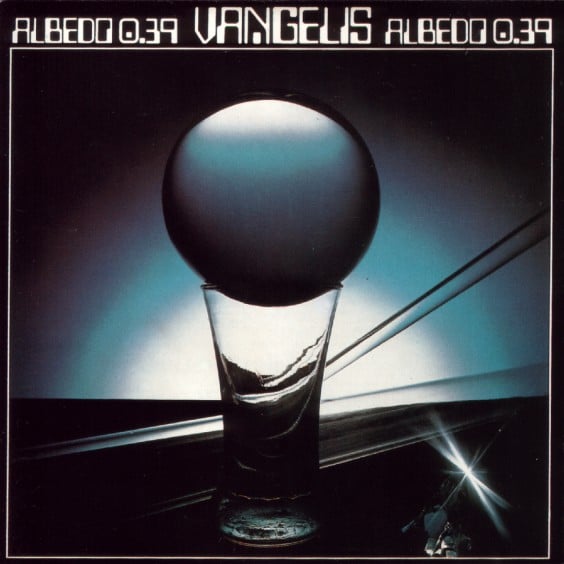
Vangelis - 1976 - Albedo 0.39

Quality: 4.25 out of 5
Trip-O-Meter: 4.25 out of 5

After his journey through Heaven and Hell, Vangelis saw it fit to launch himself into space. I think it suits him a lot better. This sounds an awful lot like the music that Tangerine Dream would make in the mid to late 80's (as well a Vangelis himself), but the funky, clunky analog sounds and 70's production makes this sound far better. The live drums that show up here and there help a lot too. Let's face it, music of this sort walks a fine line between 'awesome' and 'cheesy,' and the digital sheen of the 80's sent these sounds careening over the edge into a new age abyss. But we're looking at Albedo 0.39 for now, and it's the real deal. As far as the orchestral synthesized sub-genre goes, this is space music at its best.

For you Carl Sagan junkies, "Pulstar" and "Alpha" were a few of the tracks that were used in the phenomenal score for Cosmos. There might be some more here as well, but those two were distinctly burned into my head. "Pulstar" features some brains piercing synth stabs while "Alpha" is a perfect crescendo. The other major tracks here are "Main Sequence," which sound like a band of robots playing fusion, and the two part "Nucleogenesis," which most recalls "Heaven and Hell Part 1," except that it's rocked up and sounds far superior to my ears (was this one in Cosmos as well?). There are some enjoyable shorter pieces as well. "Freefall" has a touch of world percussion added to fine effect, and the star chart recitation on the closing title track is fun as well. I think most of my trance music listening is at least in part my trying to recapture the vibe of sitting in a planetarium at age 8, and this one does a fine job of doing that.

Yeah, this music is on the cusp of 'new age,' but I think that term usually applies to failed space or spiritual music. This album definitely gets the space dynamic correct. Vangelis certainly beat both 80's Tangerine Dream and his future self at their own game ten years before the fact.

Buy Me:
Vangelis - 1976 - Albedo 0.39

Vangelis - 1975 - Heaven and Hell

Quality: 3.25 out of 5
Trip-O-Meter: 3.75 out of 5

The way I see it, Vangelis has had four major periods in his career. There's of course his mostly awesome stint with the psychedelic rockin' Aphrodite's Child, his insane experimental/prog period of the early 70's, his 'golden artistic period' of the mid 70's and the new age drivel period he's been often stuck in since about 1979 (there are things like the Blade Runner soundtrack which definitely get a pass). This album is often seen as the start of his most artistically valid period, but to tell the truth I'm not that enamoured with Heaven and Hell. The are some touches of synth and melodic genius sprinkled throughout this record, but Vangelis was going for an orchestral prog vibe that tends to turn me off. If you're into that sort of thing, expect to add another point to the 'quality' meter.

This appears to be a side-long track sort of affair, but I think it would have been a much better for the big 'Heaven and Hell' suites to be split up, or at least given names. It hard for me to conceptualize what's here and separate the wheat from the chaff, so to speak. "Heaven and Hell Part One' starts of well, but the choral vocals get pretty silly a few minutes in and it veers a little too far towards the orchestral prog vibe for my taste. That said the last few minutes of the 15 minute long suite is the music used for the theme to Carl Sagan's Cosmos, and that stands out as one of my favorite pieces of music in general. It's just too bad that I either have to fast forward or listen to pompous choruses and synth themes bellowing into my ear. "So Long Ago, So Clear to Me" doesn't appeal to me at all. Word on the street is that Jon Anderson of Yes and Vangelis were an inspired pairing, but it seems like the most hellish thing here in my view. "Heaven and Hell Part Two" fairs a little better with it's ambient vibe, but there are still a few sections where I see happy elves dancing in the shire or Lord of the Rings pomp instead of the more tripped out soundscapes that I look for in the best 70's electronic records. Like part one, the final section is the spaciest and the best.

I suppose I'm being a little harsh with this album, but it's often held up as Vangelis' masterpiece whereas I prefer pretty much all of his other 70's albums over this one. Still, there are some spots of really great music to be found here, and if you dig Jon Anderson, then you'll have a nice treat under your pillow instead of the turd I found.

Buy Me:
Vangelis - 1975 - Heaven and Hell

30 July 2010

Ravi Shankar - 1997 - Chants of India

Quality: 5 out of 5
Trip-O-Meter: 5 out of 5

I'm still having some problems with my internet connection, but I went out of my way to share this one with you as I've been listening to it regularly for the past five years (and almost daily for the past month or two). Ravi Shankar and George Harrison are certainly not obscure fellows, but this is apparently out of print, so here we are. Despite the marquee names, you won't hear Ravi Shankar's sitar or George Harrison's voice or lead guitar. Still, this is one of the best things that either recorded in their careers. Shankar took it upon himself to arrange a number of ancient Indian chants, while Harrison took on the role of producer and contributes some acoustic guitar parts as well as some instrumental textures such as the vibraphone. This is truly transcendent music - much of the music on this blog may take on additional layers after ingesting a few psychedelic substances, but all this album needs to take you on a trip is a ray of sunlight piercing through your window.

A track-by-track review doesn't really seem appropriate when dealing with deeply religious music, so I won't bother. I will say that the chanting is top notch to my ear, while Harrison's instrumental contributions adds a little incentive for the modern rockers among us. Shankar's arrangements do include much of the East with the chanting and drones, but a fair amount of western sounds show up as well with acoustic guitars and some string embellishments wafting over the music. One session of this was recorded in London, while the other two took place in Mumbai. As such, it's not an entirely authentic Indian experience, but it is as near a perfect musical and spiritual experience as you're likely to find on a physical slab of media.

This would easily make my list of ten 'Desert Island Discs' for those of you that used to peruse the pages of Tower Records' "Pulse" magazine. I've been playing this a lot around my one-year-old daughter as what I hope is mind expanding children's music. This album is truly a part of my life and a very welcome gift from Shankar and the departed Harrison. I hope you will dig it as well.

29 June 2010

Agitation Free - 1972 - Malesch

Quality: 4.5 out of 5
Trip-O-Meter: 4.5 out of 5

Poor Agitation Free, having their members continually poached by better known krautrockers like Tangerine Dream and Guru Guru - and all before their debut album! Fortunately some travels through Egypt helped them get it together, and this album is pretty sweet. Featuring echoes of Middle Eastern music along with touches of the glacial sounds of Tangerine Dream and Klaus Schultze and some prog rock grooving, Malesch makes for a fine 40 minutes. The drumming here is well played and recorded, and the organ riffs sometimes recall something Terry Riley would target.

With a touch of early sampling, "You Play For Us Today" does a fine job setting the gliding groove that the album pretty much sticks to. "Sahara City" serves up a full blast of the Middle Eastern sounds before turning into a full-fledged freak out. Then it all comes together for the album's best track, "Ala Tul." That one makes me picture a wild solar medina (Arabic marketplace) orbiting Neptune. It's even a little groovier than the Star Wars cantina - at least in my head. The rest of the album is no slouch. The title track is only a shade under "Ala Tul" while striking a similar vibe, and "Rucksturz" sends us off with a final though of glammy, acid guitar.

While there are plenty of elements on this disc that some of the other 70's German musicians pulled off even better, Agitation Free hits their marks well and the Egyptian sounds help set this one apart. With clean production and fine playing, this is a necessary listen.

Amon Duul - 1970 - Para Dieswarts Duul

Quality: 4 out of 5
Trip-O-Meter: 4.5 out of 5

Please note that this group of krautrockers are Amon Duul, and not Amon Duul II. The original Amon Duul was a communal group of freaked-out German hippies of which being a band was only one facet, whereas Amon Duul II was an offshoot of the more musically inclined members of the commune. Although Amon Duul II is by all rights more musically accomplished and focused (while still retaining a strong avant garde edge), I tend to find myself listening to the spacey ramblings of the commune's recordings far more often. This album is the final set from the original group.

The album begins with an extended side-length jam out, which starts off with a minimalist, proto-Spacemen 3 drifter which features vocals about time machines, and ends with a long acoustic guitar driven jam. They're both well and good, but my favorite part is the echoing guitar scales and noise in the middle of the track that stitches them together. The proper album contains two fully separated tracks on side two. While it's pretty primitive sounding, I'm charmed by the chiming guitars and probing bass of "Snow Your Thirst and Sun Your Open Mouth." Paramechanische Welt" isn't bad, but it does reek a little more of screwing around in a drum circle than I'm usually happy with. The reissue contains a couple bonus tracks that make a nice addition. "Paramechanical World" sounds almost like one of the early tracks that Damo Suzuki recorded with Can.

Although not quite an ultimate krautrock classics, Para Dieswarts Duul is one of the better early entries in the genre. I'm usually not particularly attracted to jammy rock unless played by top notch musicians, but Amon Duul manages to create some very cool atmospheres even if they don't always sound completely in control of their instruments. For those of you that grab anything with an Ohr Records label, this will be a most satisfying listen.

*Note - My internet connection is still pretty screwy. I'll post when I can.

28 May 2010

Far East Family Band - 1976 - Parallel World

Quality: 5 out of 5
Trip-O-Meter: 5 out of 5

Far East Family Band was one of the absolute best psychedelic/prog bands from Japan, while producer Klaus Schultze was (and is) at the top of the electronic krautrock pile. Even with such strong credentials from the outset, this album is more than the sum of its parts. The two musical forces meld perfectly, with the best parts of their musical identities at the forefront without obscuring the other. Parallel World is how every collaboration would go down in a perfect world (a perfect world that is parallel to ours I would suppose).

"Metempsychosis" is sort of a prelude track, working a tribal groove not too far removed from Schultze's "Moondawn." Schultze's presence is felt even more with his cascading Moogs on "Entering," which eventually crashes head on with the full blast of the Far East Family Band on "Times." Yeah, they're probably echoing Pink Floyd's "Set the Controls For the Heart of the Sun" a bit too much, but I'll forgive them as I think "Times" is ultimately a superior track. We then get an extended 'sad Japanese man' psychedelic ballad with "Kokoro." It's my least favorite track here, but the quality of this album is so high that it would be a highlight on a lot of other albums. Side two consists of the "Parallel World" song suite, and of course is not to be missed. "Amanezcan" provides some modular Moog haze, while the band cranks up the voltage into some fine psychedelic funk beats on "Origin" and "Zen." The rest of the album lets the sonic DMT kick in as we're treated to some cosmic sounds that rival those on Tangerine Dream's Alpha Centauri.

Parallel World is one of the best psychedelic/prog albums of the 70's. It's definitely the best the Far East Family Band ever sounded, and it's a high point for Klaus Schultze as well. This reaches farther out into the space rock aether than most of the space rock luminaries ever managed, and deserves the ear of all the heads out there.