25 August 2011

Glaze of Cathexis - 2010 - Underground Sound

My original intention for this album was to create mono and stereo mixes to bring out the 60's style grooviness for this album, but some technical difficulties got in my way last year and I just released the mixes that I had. In fact, my work folder for the album was titled 'Mono/Stereo Album.' Fortunately, I found some ways around those problems last month and got these mixes together. The stereo mix is my attempt at a psychedelicized early 1968 vibe complete with ridiculous stereo separation, while I tried my best for an old school mono punch on that mix. If you've already downloaded the album and dig it, take a chance with these versions. If you're new to this and really want the first mix, they remain linked at the original post. Here are the notes I posted last year for the collection:

Here's the new set of Glaze of Cathexis recordings, which has been percolating since May 2009. It was originally going to be a sort of stoner metal thing, then a folk rock affair, and finally I just went straight for the marrow of my favorite 60's bands. 'Pala Ferry' has some elements of all three of those mindsets. This is a lot more guitar heavy than the last set. Every track here is anchored by guitar, and I just went to the Moog synth a few times to add some rubbery density. For once I had the opportunity to record some actual drums, so you get my spazzy drumming all over this album as well as a little bit of drumming from Gonzoriffic filmmaker Andrew Shearer. Hopefully you'll dig these psychedelic rock sounds. Here's some song notes for those of you who have the yen to listen:

Pala Ferry - At various times I was aiming for R.E.M., mid-period Byrds, and Dennis Wilson on this track. I think the Beatles 'Rain' was stuck in the back of my head as well. Lyrically, this is an invitation to join my cult, which doesn't actually exist. I always got that sort of vibe from the Millennium's Begin, which was my first post on this blog and is one of my absolute favorites.

Further Instructions - Here I'm commanding you to do abstract and impossible things. In my head it was going to be a fireside, smelly hippy folk rock chant, but then some Talking Heads style beats, Chuck Berry guitar riffs, and the goofier side of the Beach Boys backing vocals invaded my muse as well. This comes in second as I wanted to continue laying down the groundwork for my meaningless cult.

Launch - I'm not sure what this one's about lyrically, but I wanted to go for a Black Sabbath sort of riff heavy song. Some Cream found its way into the wah-wah'ed out lead guitar as well. Apparently my attention span ran out as the coda takes a sudden and strange turn into electronica.

Sign From Your Face - This is another one from my folk rock phase, and I was going for a Rubber Soul sort of vibe here. One with the Harrison parts being beamed in from the early 70's. My original vocal take tried to emulate Lennon and Dylan all at once, but it sounded ridiculous so I ended up dialing it back for this finished version.

Blues For A Red Planet - This is from a basement jam with Andrew Shearer on drums and myself on rhythm guitar. For the overdubs, I ran my Moog for a vacuum tube for the first time, and I kind of got off on it. I couldn't find my guitar slide for the lead guitar overdub and ended up using a plastic ear cleaner instead. The title is from an episode of Carl Sagan's Cosmos, which you should all watch right now.

Sometime With You - This song has been bouncing around in my head since my university days ten years ago, so I had to record it just to get it out of my damn head. Actually, the lyrics in my head were far dumber, but I was able to get away from those.

My Little Utopia - I wrote this sitting on a 50 meter cliff on a small Canadian island about seven years ago. I re-extrapolated the melody of the Dean Martin standard 'Melodies Are Made of This' for this track, but if Brian Wilson can get away with turning 'When You Wish Upon a Star' into 'Surfer Girl,' I might be safe.

City of the Domes - My buddy had just put a bunch of Iron Maiden onto my ipod, and I got the urge to write that kind of guitar riff and meld it with a tacky sci-fi reference. When it came time for the vocals, I found that I couldn't do a convincing metal growl, so I defaulted to glam Bowie instead. The electronic coda here has a little more relevance if you've spent some time with the strangely awesome film 'Logan's Run.'

Cliffs - I wrote this one back in 1999 on a bit of a bender in my college dorm room. I had recently been introduced to Syd Barrett's music at that time, so this is one of the Barrett-iest tracks I've come up with. I could never get quite happy with a recording of this, but it turned out that it needed those swinging Soft Machine-style drums.

Visions of the Unreality - This is another basement jam with Andrew and myself. My frequent collaborator Scott Atkinson crops up here with a bit of visionary poetry. It's actually the first time we've worked on music together while in the same room (or same country for that matter).

It Means a Lot - Ironically, the lyrics pretty much mean nothing. I set out to rip off "Yur Blues," but got sidetracked by another period of obsession with the Doors, and then decided to top it all off with my Dylan vocal impression. I guess I was getting into that whole Dukes of Stratosphear 'be your favorite band' sort of vibe.

Centrifugal Bumble Puppy - A gold star for those of you who get the title reference. I set out to write a song of my surreal and false triumphs, with each line starting with "I" and then a different verb. Music wise, I wanted to do a 'dude' version of the dronier and harder rocking Stereolab tracks.

Taking the Time Out - This one kept popping up in my head as a crappy emo punk song, but I think I successfully guided it into 'Who' territory instead. If I ever make it onto a neo-Nuggets compilation, I could imagine this being the one.

Hope you dig this stuff. I'd love to hear your comments and impressions, even if you end up thinking that this is a steaming pile of poo.

18 August 2011

Iasos - 1975 - Inter-Dimensional Music

Quality: 4.5 out of 5
Trip-O-Meter: 4.75 out of 5

Here's an album that I know almost nothing about, but have found myself listening to incessantly. I imagined that Iasos was some kind of new age commune. If you visited their home, I thought you'd find them doing yoga while wearing tight pastel yellow tights and tank tops and frizzy hair, after which then insist that you join them for a trip to the wood-paneled vegetarian supermarket. I didn't want to spend time with them, but I was infatuated with their sounds. Then I look at the All Music Guide, and it said that Iasos is actually one guy who is considered one of the first artists of the new age musical genre. It kind of deflated my vision behind this album, but fortunately the music is still great. Yes, it is new age, but of the 70's variety with analog synthesizers and hazy, groovy taped production (as opposed to the Great Digital Recording Terror of the 80's). Yeah, it probably would have played in that wood-paneled health food store in the 70's, but you would have enjoyed the music and maybe you could have found that awesome Panda cherry licorice somewhere in the aisles of the store.

This is another one of those albums that really works as a continuous whole. It loses quite a bit of its vibe if you isolate the track. That said, when I'm particularly enamoured with a tune and take a look a the track listing, I've found that it's usually "Formentera Sunset Clouds," "Rainbow Canyon," "Angel Play," or the closing "Maha Splendor." The first half of the album tends to be the more tuneful half. Once Iasos 'gets you in the mood' so to speak, the music becomes far more ambient. This does end up making the second half a little more murky sounding (although "Angel Play" shines quite well) and "The Bubble Massage" ends up being just five minutes of percolating bubble sounds, which I could achieve on my own by sticking my head into a jacuzzi.

Really, though, this album is quite a trip and a very groovy musical time capsule of its era. It's on a slightly different plain of existence than Berlin schoolers like Tangerine Dream or Klaus Schultze, but these sound would actually complement those artists very well. So light your opium scented candles, recite a few verses you've memorized from the Bhagavad Gita, jump into your giant round hot tub with several big-haired sexually liberated women (or hairy chested, medallion-wearing men), and give this a play.

17 August 2011

Helium - 1997 - The Magic City

Quality: 4 out of 5
Trip-O-Meter: 3.75 out of 5

I have a bit of a strange history with this band. I was introduced to Helium by a show in Atlanta back in 1998 while under a, uh, somewhat altered state, and then never got back to listening to them again until a few weeks ago. Still, they stuck around in the back of my mind and I probably should've returned to them earlier. The band, led by singer/guitarist Mary Timony, is basically a mid 90's indie-rock affair, but they distinguish themselves quite well with touches 70's prog and a few echoes of shoegazing. Honestly, this is far from outright psychedelic rock, and several steps away from the music I typically rant and rave about on this blog, but I dig it.

The satellite pulsin', girl-group-of-the-future-sound of "Leon's Space Sound" is a pretty hooky place to get acquainted with this album. There's a very groovy string synth riff bubbling just under the surface. "Medieval People" is a standout instrumental, although I imagine that the people in the title are heading for some kind of day glo, Authurian rave or something. Actually, I think they mixed up the titles with the also fine, short instrumental "Blue Rain Soda." Just swap them and it makes far more sense. "Lullabye of the Moths" sort approximates something that might have sprung forth from the late 60' UK psychedelic pop/folk scene, while "The Revolution of Hearts Pts. I & II" really does run too long at eight minutes, but sort of makes up for it with an array of insane sound effects later in the track.

This album probably requires a strong tolerance with some of the more stereotypical sounds of 90's rock, but having said that, it's one of the better albums I've heard that functions within those perimeters. I'd certainly place this far above most of Juliana Hatfield's or Liz Phair's discography (although I'll give Phair's first album a 'get-out-of-jail-free' card). There are some nods to vintage psychededia lurking in the production that really do enhance the songs and for me qualify this set for a mention here at the Psychedelic Garage.

27 July 2011

The Incredible String Band - 1968 - The Hangman's Beautiful Daughter

Quality: 4.75 out of 5
Trip-O-Meter: 4.5 out of 5

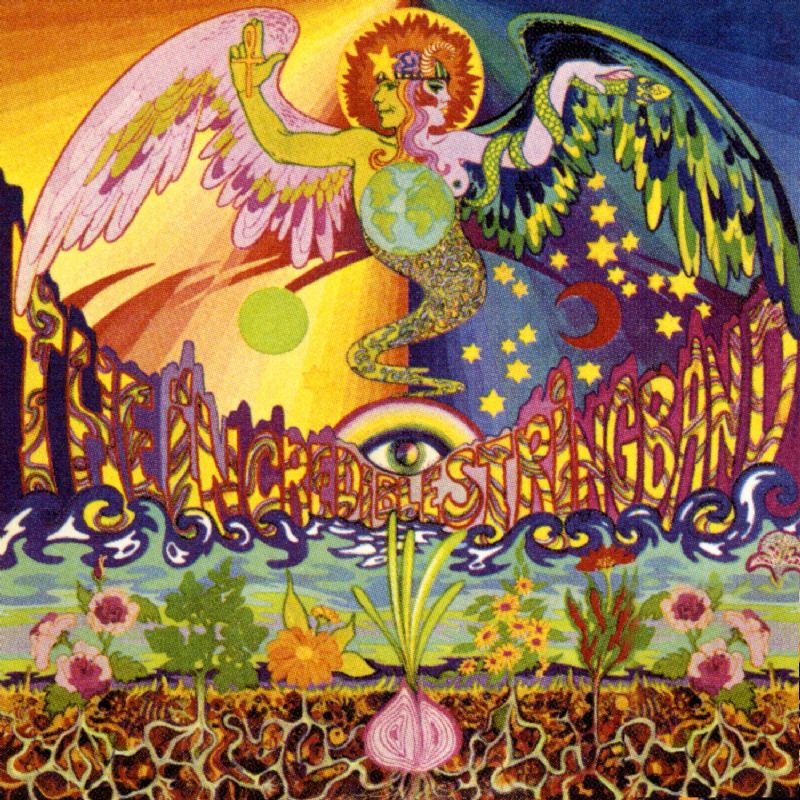
The Incredible String Band and their producer, Joe Boyd, managed to bottle up everything that was groovy about their previous album and lace it with some prime Supercool. The sound of the recording is notably beefier and more nuanced, and both Robin Williamson and Mike Heron's songwriting and actual singing voices seem to blend together a bit better here. Although the album cover can't touch "5000 Layers of the Onion," this is arguably the sonic apex of acid folk in general.

With the musical synergy seemingly in full effect, this album lacks the ping-ponging song credits of the last album. Instead, we start off with a clutch of Williamson's songs. "Koeeoaddi There" is likely the group at its catchiest (although I doubt this could manage much radio play), although Williamson does amusingly randomly bounce around from one theme to the next, but it's balanced by the great trancey guitar work. There's some really entertaining vocal affectations and call-and-response on "The Minotaur's Song," and it ends up sounding like something the villagers from "the Wicker Man" (the Christopher Lee one, not the Nick Cage one) would have rocked through in the pub on a Saturday night. Heron clocks in with the first of the band's epic length tracks, "A Very Cellular Song" (unfortunately, I can't help but think of mobile phones here in the future). I'm not sure it really justifies its 13 minute length, but the various, droning sections and oddball sound effects remain entertaining. Personally, I dig Heron's percussive and concise "Mercy I Cry City." Williamson is a little more tentative with his epic track only clocking in at eight minutes, but his sitar infused "Three is a Green Crown" ranks as one of my favorite tracks here. "The Water Song" provides some very groovy pads of woodwinds, but do they really fit with the Incredible STRING Band?...... yes, they do.

If you have any need for some acid folk in your life, this very well be the best place to go. This is the ISB at their best as an acoustic unit. After this, they'd start mucking around with a few electric instruments, and eventually end up as more folk-rock sort of band. They never really did the electric thing as well as Dylan, however, and this album stands tall as their masterpiece.

The Incredible String Band - 1967 - 5000 Layers of the Onion

Quality: 4.25 out of 5
Trip-O-Meter: 4.25 out of 5

First off, this is one of the most awesome albums ever. I first picked this up while in high school in the mid 90's as it looked to be a notable freak out and I'd heard the band's name spoken of in reverent tones. Unfortunately, I hadn't even gotten to electric freak outs like 'Piper at the Gates of Dawn' yet, and have to admit that I didn't really 'get' this one for years. This is straight up acid-folk, without any electric embellishments. Of our main duo, Mike Heron tends to walk more the Dylan/Donovan continuum, although with his own voice very loud and clear, while Robin Williamson is more like the crazed minstrel hopping out at you from atop a tree in a fog-filled primordial forest (although they admittedly do drift into the other's role on occassion). Both of the excel in writing completely tripped out whimsically British lyrics that make Syd Barrett look like a rank amateur - not that Barrett isn't awesome, but the lyrics of "The Gnome" don't do well when placed next to "The Mad Hatter's Song." Williamson had also recently taken the hippy tour to North African, and sounds from that area abound as well as the sounds of other incredible stringed instruments such as the sitar.

If your ears are open to the folk scene, you'll find this album is packed with absolutely top-notch songwriting. In fact it's far easier to talk about what doesn't quite do it for me. "Blues for the Muse" tries really hard to stretch the 12-bar blues somewhere interesting, but this group still fares much better with the British Isles folk template than the blues. "My Name is Death" take the 'death' concept a bit too literally sonically, and it sort of drags the song down. Although it's only 2:46, it is the longest song on the album (despite some tracks running 5:40 or 4:05 or something; I can type more numbers if you like). Fortunately the list of winners pretty much includes everything else on the album. I particularly dig the first four tracks, "First Girl I Loved," and "You Know What You Could Be." If I ever ran the Renaissance Fair, you'd eat mushrooms instead of a turkey leg, and then you'd listen to this band. There'd also be giant, iron robots there.

Just for a bit of name checking, this set had psych/folk guru Joe Boyd in the producer's chair, and the legendary string bass player Danny Thompson shows up on several tracks. Basically, as far as acid folk goes, this album is setting your rear in the middle of the royal court. And let's just mention that phenomenal album cover one more time. I should get it tattooed on my brain or something. Huh, huh... yeah!

11 July 2011

Kimio Mizutani - 1970 - A Path Through Haze

Quality: 4.25 out of 5
Trip-O-Meter: 4.25 out of 5

I'm a little hesitant when I come across the term 'prog rock.' When musicians can work it towards a spacey groove rather than multi-suite wankery, though, that form of music does get my attention. With that in mind, we'll peg this one as a 'prog rock' classic. Kimio Mizutani was a psych rockin' session guitarist who created this album for his solo debut. He's got pretty awesome chops, and collaborated with some classical chamber groups on this album. Typically, the classical prog turns me away as well, but the band is smart enough to respond to the more orchestrated moments with a jazz vibe. Even Frank Zappa, who often recorded this way as well, tended to miss the point when he'd have his guitarists play rapid-fire walls of intricate guitar when a melodic solo would have done nicely. Mizutani doesn't make this mistake.

This set starts with several awesome tunes. The opening title track does indeed provide some nice jazzy haze, cut straight through with a monster riff from Mizutani's guitar supported by some groovy, Ginger Baker-like drums and streams of strange electronic noise. Once "Sail in the Sky" gets going, we're treated to a fusion vibe which features a very complementary woodwind arrangement. "Turning Point" sounds surprisingly like the post-rock band Tortoise, who wouldn't start recording until about 25 years after this album was released. "One for Janis" might not be the best tune for Janis, but it does give us another riff monster which is pretty fun. On the lesser side "Tell Me What You Saw" veers into hamfisted atonality which actually sounds pretty much the same as Phish jamming (although I'm sure that's a positive point for some of you), and "Way Out" doesn't tend to fit in very well as the only track with vocals. It comes out sounding like early-Return to Forever's vocalist stumbling into a funeral as the music is rather dirge-like.

Yeah, so this is prog-rock that I can be down with. The jazz vibe seems beamed in from the Canterbury scene, while the construction recalls Zappa, although without the 'too many notes' problem. Also, Mizutani is more than sharp enough to have a few of his own tricks up his sleeve and his guitar playing is psychedelically impeccable.

Kalyani Roy and Ali Ahmed Hussein - 1968 - Soul of India

Quality: 4.5 out of 5
Trip-O-Meter: 4.5 out of 5

I'm going to go ahead and guess that this release was intended to latch onto the coattails of Ravi Shankar's appearance at the Monterrey Pop Festival (in fact, Ravi's 1968 release was 'Spirit of India') along with a general interest in Eastern mysticism. Fortunately, this is no exploitation release, but legitimate Indian musicians doing their thing. Kalyani Roy was one of the few female sitarists at that time, while Ali Ahmed Hussain is wailing away on a shehnai, which is a wind instrument that sounds somewhere in between a violin and a horn. You'll get the needed dose of tabla pounding as well. Expect a completely traditional affair, with no postmodern touches or anything.

There's only three tracks here, so you're either 'in for another long raga' as Krusty the Clown would say, or you're not. If you're down for this kind of thing, this album is an affair with lots of color added to the general raga vibe courtesy of the shehnai. I enjoy the whole thing, but honestly, I don't know enough about classical Indian to really distinguish much between the tracks. They all seem to more or less go down the same sonic path - but the trail is clearly being led by master musicians.

I've played this collection often, and I've sort of considered it one of my 'mind bubblebaths.' I don't tend to fixate or concentrate on the actual music much, but it creates a cloud of sound that I find very appealing. I'm sure there are some major musical point or accomplishments that I'm totally missing here, but something about the spirit of the recordings has definitely burrowed in my brain.

24 June 2011

Tim Hollier - 1970 - Tim Hollier

Quality: 3.75 out of 5
Trip-O-Meter: 3.75 of 5

Tim Hollier clearly dug Tim Buckley's early records. This disc is sort of a slightly psyched-up 'Tim Buckley-lite" affair that manages to hold one's attention pretty well. Hollier's voice is very pleasant and tuneful, although he can't really touch the wild dynamic range of Buckley's voice. The production is is a little muddy sounding, but in a fuzzy way that complements the music pretty well. Although folk-rock is clearly the order of the day, the band does work up a groovy head of steam to give the songs a nice sonic push when needed.

Most of the tunes here are pretty solid, though only a few really stand out. Despite some really clunky, cliched lyrics, "Seagull Song" worms its way into your head with a fine folk melody and some groovy guitar and flute leads bouncing about in the background. "And It's Happening to Her" and "Love Song" are very catchy ballads, with some guitar leads that seem to echo the late night soul vibe of the guitars on the Velvet Underground's third album. "Evolution" is the longest tune here, and finds a pretty fine sweet spot between Buckley, the Byrds, and a touch of Dylan. "Evening Song" is a fine tripped out coda with Hollier's ghostly vocals searching through a forest of tremelo guitar.

I keep referencing American artists, but Hollier is a Brit and the echoes of that islands folk traditions are on display here. Still, it's clear that Hollier likely had a large pile of L.A. folk-rock vinyl taking up space in his 'flat.' This set isn't really a mindblower. It's probably not going to change your life, but it's a very groovy concoction while it's playing - although I do occasionally wonder why I'm not just listening to Tim Buckley's "Goodbye and Hello" instead.

23 June 2011

Rex Holman - 1970 - Here in the Land of Victory

Quality: 3.5 out of 5
Trip-O-Meter: 3.5 out of 5

This album is a reasonably entertaining set of sort of mellow, singer-songwriter light psych. The production has a nice think woodsy sound, and the songwriting is rarely embarrassing. Holman has a pretty strong 'dude-with-a-mustache' voice, although his vibrato often gets a little out of control - it's like he's singing in a fan or something. Still, this music sits in a strange grey area between Kris Kristofferson and Donovan that should hold your attention for a bit.

The best tracks here blend Holman's 'manly-hippy-on-the-moors' sound with a bit of an Eastern vibe, which basically means a few bongos and a sitar. "Rowin'," "Sit and Flatter Me," and "Debbie" all ride this sort of groove pretty well and are probably the best tracks here. "Debbie" especially has a cool shuffling rhythm and makes me think of Scott Walker before he started using slabs of meat as percussion. I also dig the twilight psych of "Copper Kettle" and "Come On Down." Yeah, for some reason side two seems to be the superior side. Well, the opening title track is pretty solid as well, adorned with chimes, flute, and a catchy Brit folk melody. It's also worth mentioning that Rex doesn't rock. He sort of, kind of gives it a shot on the bluesy "Red is the Apple" and the 'Dylan as bubblegum pop' "I Can't Read My Name," but, y'know, they're both still pretty mellow when you come right down to it.

In full disclosure, this isn't quite up my particular musical alley. I'm definitely cool with the psych and Eastern touches, as well as the general British folk underpinnings, but this really is halfway down the Wonder Bread, 70's singer-songwriter hallway. If you've got a 'thang' for that sort of thing, then you'll probably have some additional appreciation for these recordings.

10 June 2011

13th Floor Elevators - 1968 - A Love That's Sound

Quality: 4 out of 5
Trip-O-Meter: 4 out of 5

The third 13th Floor Elevators album, "Bull of the Woods," has always been somewhat of a disappointment. The band had pretty well disintegrated from legal troubles, insanity and various other pressures. With vocalist Roky Erikson and lyricist/electric jug player Tommy Hall pretty much out of commission, guitarist Stacy Sutherland did the best he could and he did manage to pull off a pretty good psych rock album. The problem was that it didn't really deliver as an Elevators album. This collection gives us a much groovier view of what a real third Elevators album could have been. Rocky Erikson sings on all of the tracks that feature vocals, even if a few of them are likely just guide vocals, and the band rocks a lot closer to their signature sound. The monoural sound quality is somewhat muddy, but us longtime Elevator fans should be used to that from years of substandard versions of their first two albums. The electric jug only shows up on one track, but let's face it - the jug was always a bit of a novelty and the band does pretty well without it. Also, we get to lose those damn horn overdubs which marred "Bull of the Woods."

The first six tracks here are first rate, if a bit rough, 13th Floor Elevator rockers and stand up pretty well in comparison to the classics on the first two albums. "It's You" is a fine display of the poppier side of the band with a chorus that will end up stuck in your head forever, while "Livin' On" and "Never Another" serve up a tighter version of the psychedelic guru vibe that the group pursued on "Easter Everywhere." Erickson's version of "May the Circle Be Unbroken" is one of the group's absolute masterpieces, although it does admittedly come across a little better in its stereo version on "Bull of the Woods." Since the first six tracks only clock in at about 22 minutes, the disc is filled out with some instrumental takes called "Sweet Surprise" and "Moon Song." They're relatively dispensable, with the former coming across like a blues based jam and the latter sounding like a rocked up version of "Postures (Leave Your Body Behind)." Still, they're a nice momento of the prime Elevators sound just before it was lost forever.

I typically shy away from recent releases, but I imagine many of you may stay away from this release due the somewhat poor reputation of "Bull of the Woods." Surprisingly, this document of the band is almost as essential as the first two albums. If you have any doubts, note that this is actually the first disc of the set while "Bull of the Woods" is relegated to the second disc. There are some pretty interesting liner notes included as well. Buy it - Roky deserves the royalty checks.

Buy Me:
13th Floor Elevators - 1968 - A Love That's Sound

03 June 2011

We're Late For Class - 2011 - Music of the Spheres

Quality: 4 out of 5
Trip-O-Meter: 4.25 out of 5

These psychedelically-minded musical bloggers have been blasting a few tunes our way every now and again for a few years now, but I think this is one of the better efforts I've heard from them. We're Late For Class is a rather free-form grouping that records whatever abstractions fits their mood at the moment, and it seems that they were in a jazzy, space rock mood for this one. The production quality here is also a nice step up, with a hazy, crisp vibe propelling the sounds into interstellar space. I'm also a sucker for the kind of cosmic cover art that this one sports, and the music reflects it pretty well.

We've got two tracks here that almost form a bit of a musical suite. "Blood Queen of Sun Ra" shuffles along the rings of Saturn, and includes some groovy samples from god knows where. "SOL's Time and Space" drifts along a more conventional, but well played Floydian strut. There's some vibraphone, or xylophone, or somethingmaphone that brands the track with a nice, unique musical identity.

When you need a quick fix of modern psychedelic jamming, We're Late For Class serves well as your sonic dealer with almost 60 shorts sets to tickle your ear. Have a gander at their offerings here: We're Late For Class

Listen to Me:
We're Late For Class - 2011 - Music of the Spheres

02 June 2011

Sister Waize - 2011 - Realignment Series

Quality: 4 out of 5
Trip-O-Meter: 5 out of 5

To many, it may seem that creating a drone is a simple procedure - just sit on one note of your synthesizer for 20 minutes or so and let 'er rip. I've given it a shot on several occasions, though, and getting it right is not so easy. This album, happily, gets it right. Sister Waize's latest release isn't so much music as a set of experiences for you to enter. David Mekler, the fellow behind these, calls his recordings 'folding drone music.' I don't quite get that concept, but put these on in the right frame of mind and the visions will surely come.

I typically like to ramble on a bit about the songs, but the tracks here pretty much defy description. Even Mr. Mekler doesn't suggest playing more than one or two of these at a time. In fact, he's created a set of instructions to go along with these albums. I can't write anything better than the man himself, so here's an extended quote to get you ready for this psychedelic dark ride:

"1. Listen at night, before going to sleep. Make sure you are not too tired though because it will be very easy for you to just fall asleep.

2. Be in total darkness, pitch black.

3. Lay in your bed, on your back and make yourself as comfortable as possible. Lay for a minute or two until you've settled into your bed before you start the track.

4. Make sure there will be no interruptions that will take you away from the track before it ends, the whole thing must be listened to in one sitting without interruption (this is extremely important, think about it as losing your train of thought and then trying to continue).

5. Only use decent headphones/good headphones. Do not use earbuds by any means, you will just be wasting your time. Sennheiser is my personal brand of choice, you can easily get a great pair of headphones from them for less than $50.

6. While listening try your best to keep your eyes closed and body still as much as possible. It's very difficult to avoid fidgeting for 20 minutes or so, but try your best. This is so you can give complete attention to the sound as it moves.

7. Keep your mind on the sound and let your mind ride with it. Letting your mind wander is fine, but don't get hung up on anything specific for too long. Just try and let go.

8. If you can, stare at the back of your eyelids while you listen and focus on the colors. This is where the inner eye hallucinations can usually come from, don't stress it too much though, keep most of your attention on the sound.

9. Most songs that I've made which are applicable to what is being talked about here are shorter than a television show... keep this in mind before listening. Understand how long the track is exactly so that you know ahead of time. I say this so that you won't start to think about when it will be over while the song is in progress. I promise you, it will end eventually. They are as long as I feel they need to be, and as short as possible."

I followed the instructions and ended up with a pretty surreal meditational experience. It's certainly far removed from typical music theory, but it serves its intended purpose quite well. It's sort of like what Lou Reed's "Metal Machine Music" could have been if Reed wasn't so busy trying to stick it to the record company. Give it a listen when you're ready. In fact, it's pretty late at night here in jolly old Japan, and I do believe I'm going to go ahead and trip out to a track or two right now. For more of Sister Waize's sonic world, head for this website:
Hidden Dojo

Listen to Me:
Sister Waize - 2011 - Realignment Series I
Sister Waize - 2011 - Realignment Series II
Sister Waize - 2011 - Realignment Series III

31 May 2011

The Nirvana Sitar and Strings Group - 1968 - Sitar & Strings

Quality: 3 out of 5
Trip-O-Meter: 3.5 out of 5

I'm always up for a psychsploitation album early in the morning (oh crap! it's 11:30am), and this one can certainly fill in for the cheese missing from my eggs. Just as the title sort of suggests, we've got a bunch of late 60's hits with the melody lines played on a sitar while 101 Strings-style orchestrations lumber on in the background. You're either in for this ride or you're not.

There's not a whole lot to say about most of this album. These aren't going to replace the revered versions of "House of the Rising Sun" or "The Letter," but they'd make for a wonderful bit of ironic film soundtracking. They did throw the sitar player a bone, however, and let him run wild in the studio for a few original tracks. "Crashing," "Mind Waves," and "Head" all ditch the strings, throw in a few tabla, and give us sort of the Whisky A-Go-Go, L.A. Strip sort of Indian meditation. As you probably know, I'm a sucker for this kind of thing, and those tracks kick up my appreciation of this monstrosity a bit. They actually sort of, kind of match the very groovy cover art, which you can't really say for the rest of this album.

This is a sort of a 'for connoisseurs only' type of release. If you're on the fence about it, you'll find far groovier things hanging around in the Psychedelic Garage,' but I know a few of you are going to dig this (even if mostly ironically).

A Large Chonker of Daevid Allen's Legacy

Linking guru srecko ujka has been busy adding links for a bunch of obscuro releases from Gong kingpin Daevid Allen in the comments section for Pierre Moerlin's Gong - 1979 - Downwind. I guess it's an inside joke that he put the links on the post for a Gong release that doesn't feature Mr. Allen - the fellow is definitely up on his Gong history (more than myself, really). Thanks for all the links!

19 May 2011

Damaged Tape - 2011 - Ambiguous Reality

I'm always trying to keep from stagnating in my own music, and I think this new set of Damaged Tape recordings takes a step in a notably different direction. The first Damaged Tape album, "Electronic Ocean," was recorded with a very different set up than I have now, and I've been trying to return to the hazy, moody atmospheres of that album ever since unsuccessfully. I think I've finally managed to do so here. There is very little drum programming, and many tracks are based on arpaggiator riffs from my various synthesizers. I often start to make an ambient type track, but eventually find myself drifting in a different, more elaborate direction, yet much of this music makes for what I think is very groovy, shapeshifting psychedelic wallpaper. I had also been listening to a lot of 70's Vangelis during these sessions, and I think "Mathematics of the Genome" and "Sandcastles of Paraguay" hit upon that vibe quite nicely. I've also accepted that I play guitar a lot better than synthesizer, and I tried to mix in plenty of guitar work with the electronics - in fact, "Wheels of Vishnu" barely has a synthesizer in it. I've also been trying to live up to the Damaged Tape monkier a bit more, and have been trying to record with a little more warped sound and grit. While I'm still happy with albums like "Futara" and "Stone God," they sound a little more sterile and polished than I really wanted.

While I do the instrumental heavy lifting, this music would not be the same without the contributions of Scott Atkinson. I always dig his cosmic poetry, and his guidance as I'm recording is invaluable. He's also the fellow who comes up with the song titles (except for the last one), which I think gives the recordings their identity.

A couple of these tracks were recorded with my old roommate Devin Carlen in a late night, wasted recording session. I gave them a listen recently, and a few had a very freaky experimental edge that I still found entertaining six years later. Just as a warning, if you listen to "Waiting in a Time Capsule Trapped in Outer Space" on headphones, it may actually drive you insane - that or make you vomit from disorientation. Either way - you have been warned.

Ah yes, and the fellow you almost see on the cover is Mark Malek, a good friend of mind who I've played in bands with over the years and made a few entertaining Glaze of Cathexis remixes that I'll need to post eventually. We were in downtown Atlanta on our way to Mai Tai night at Trader Vic's when that was taken.

Anyway, here's a track listing for "Ambiguous Reality." I'd love to hear your comments about the songs:

1. The Fluorescent Darkness (2:19)
2. Pilgrimage of the Cosmic Warrior (4:32)
3. Victorian Era Phantoms of the Ganges (2:00)
4. Wheels of Vishnu (5:42)
5. Dance of the Stained-Glass Shamen (4:32)
6. The Tryps to Saturn (2:19)
7. Mathematics of the Genome (3:24)
8. Sandcastles of Paraguay (4:17)
9. The Tropical Glacier (4:07)
10. Ambiguous Reality (8:57)
11. Waiting in a Time Capsule Trapped in Outer Space (4:20)

Listen to Me:
Damaged Tape - 2011 - Ambiguous Reality (256kbs mp3)
Damaged Tape - 2011 - Ambiguous Reality (full quality part 1)
Damaged Tape - 2011 - Ambiguous Reality (full quality part 2)