27 April 2012

Between - 1974 - Dharana

Quality: 4.5 out of 5
Trip-O-Meter: 4.5 out of 5

     Between continues their decent down the rabbit hole here, cranking up their world fusion voltage on this LP.  I certainly wouldn't accuse these Germans of copying Mike Oldfield, but the dense walls of arpaggiated sound does echo some lessons learned from that artists "Tubular Bells."  Of course, here they relieve the tension by juxtaposing that sort of thing with tricks like throat singing.  The rugged krautrock vibes of their last album are played down here for a journey to the center of your soul.  You need to be up for a meditative ayahuasca space ride when you throw this one on the turntable (or more likely hit 'play' on your mp3 player).

     Again, the star of the show is probably the title track, running more than 20 minute and giving you the closest experience that you'll get to mind dancing with the Peruvian Amazonian shaman short of hiring a boat in that direction yourself.  "Joy... Sadness... Love" recalls a touch of Terry Riley-like oscillating organ set amongst a chant and flute led drone.  "Listen to the Light" presents us with a dew-dripped mind voyage into the primordial garden of delights, while the closing "The Voice of Light" is a stew of ambient sound and chanting that encases your being into warm carbonite.

     This music existed a few steps outside of typical existence when it was released, and it still sounds like it's being broadcast from a hyperspace cosmic bubble.  It's a very groovy thing to massage your mind and presents us with a intriguing alternate history of the boundless musical scene pulsing out of Deutschland in the early 70's. But what do I know?  I'm just sitting here slamming chu-hi and rambling about tones that you've just got to hear for yourself.

Between - 1973 - And the Waters Opened

Quality: 4.5 out of 5
Trip-O-Meter: 4.25 out of 5

     This is an early effort in the fields of what we now call world fusion and new age.  The group originated from Germany and definitely had a hint of the krautrock vibe that emanated from acts like Popol Vuh, Can, and Tangerine Dream, but I wouldn't quite put this under the banner of krautrock.  Basically, the rock is missing.  Fortunately, this doesn't turn out to be a problem.  Between gives us some very groovy early ambient vibes and this music exists in that rarefied air when new age still had a worthwhile hangover from the hippy supernova of the late 60's and before it curdled into a layer of cheese.  Strange sound effects and tribal drumming run rampant here.

     The opening title track makes a strong case as the main event.  It comes across a little like the first couple of Popol Vuh albums, rife with percussive craziness but replacing the Moog tones with flutes, a touch of acoustic guitar at the end, and God knows what floating layers of sound to mark it as a minor masterpiece. With "Uroboros," the group takes us through an astral dream flyby of a caravan on the Silk road, while "Syn" brings in the bass synths to send warbling ripples through your mind.  I suppose "devotion" ranks as their echoing, should've been, would've been, chanting drum circle hit single in an alternate dimension.  The epic length "Happy Stage" and "Samum" make up a mini-suite that drops your wandering spirit into a ancient faux-Indian court where the blue smoke of sacred opium wafts through the air.

     This music exists at a happy crossroads that puts firm pressure on more than a few of my aural pleasure centers.  Hopefully it does the same for you.  The spinning reel-to-reel recording and the consultations from krautrock pioneers set it several squares apart from the saccharine bliss merchants that would come to define the new age sound by the mid 80's.  You can fill your ear with the real deal here.

04 April 2012

Damaged Tape - 2012 - The Floating Existence

There's no particular concept to this album, it's really just a set of psychedelic musings. Pretty much all of the music here spilled out rather effortlessly over the past few months. Making music for me never feels too much like work, but this one was even more fun and games. I think it helps that everything here is analog hardware (with the sole exception of the robotic voice on the first track), so I didn't have to endure any programming cyber-headaches. There's also more guitar present than on other Damaged Tape records - I honestly can't really play keyboard that well, but I can rock it funky on guitar. I've also included a few tracks with lead vocals, which is a first for Damaged Tape. If my music evolves, I'm happy, and I think this one has a somewhat different vibe from other sets I've done for the Damaged Tape project. Here's some track-by-track notes for your perusal:

1. Shadows of the Future - Probably the closest we get to this dance floor on this set. The opening sample is from Alan Watt's brain-blowing "Om" from "The Sound of Hinduism," which you'll find elsewhere on the blog. My image for the second half of the track is of a bunch of robots blasting you with lasers while pontificating on their robot philosophy.

2. Craters of the Sun - I sit around playing Tetris and listening to classical Indian music a lot. Of course, many of you know that I have a sitar obsession. Unfortunately, I don't have a sitar, so my electric guitar will have to do for this faux-raga.

3. Melted Into Angel Form - Here's another second solar track in a sort of mini-suite of hymns toward the sun. I was trying to get my Eno on a little more than usual for this one. If you can figure out what movie I based the lyrics on, then you may have ESP.

4. The Solar Petroglyphs - I guess this really makes more sense as a Glaze of Cathexis tune, but the track did start with the percolating synths and I like it here. The lyrics are a mixture of good and bad advice. It's up to you to parse out which is which.

5. Sharkfasting of the Wyld - It's a shojam! This one has kind of a weird swing that I don't think shows up in electronic music too much. You'll have to ask Scott what he's talking about on the track.

6. Bohemian Astronaut - Not quite a hippy in space - a little sharper than that. We'll dedicate this one to Harrison Schmitt, the only scientist who made it to the Moon during the Apollo program. Maybe that made him seem a touch bohemian amongst all the navy and air force dudes.

7. Tara Poets and Edo Priests - Or maybe it's the other way around as the file name says. Honestly, I sort of forgot. Hell, both ways are fine with me. Until Scott made his contribution, I had an unfortunate urge to name this track "The Hippy Revolution," but it has to be an exploitation revolution like you can see in the double feature DVD "Wild in the Streets/Gas-s-s-s"

8. Conversations With the Psychedelic Wyzard - All of these tracks started off with the file name "cheecream," but this one really earns its title. We've got a question posed by the lead synthesizer, and answer from the lead guitar, and another response from the synth over the course of the track. You can decide which one of these voices is the psychedelic, uh, wyzard.

9. Magnetic Vulcanology - The initial tune made me think of a synthesized communist anthem or something, and then I decided to do the Cookie Monster for the vocals. I don't think I can touch Tom Waits Cookie Monster impression, but I am a big fan of both of those iconic figures.

10. A Dedication of the Deserts - I may need to get Scott to post a bit about the intentions of his words. Although it is ostensibly about the deserts, I keep feeling that it's more of a peace, love, and tantric sex thing. I don't know, the artist is typically the worst person that you can ask, "So, what does it mean?"

11. Tribal Physics - I think I figured out how to make my Roland Juno 60 sound reasonably like a Fender-Rhodes electric piano - at least that's what I was going for. Something deep inside of me thought about naming this album "The Happy Bongo" as well. This track is further support for that idea.

As always, I'd love to hear your comments, and if you dig the sounds, you're welcome to repost. Let me know if you do.

Listen to me:

30 March 2012

Robert Fripp - 1980 - God Save the Queen/Under Heavy Manners

OHMYGODTHISALBUMHASTWOCOVERSIDONTKNOWWHATTODO!!!
Quality: 5 out of 5
Trip-O-Meter: 5 out of 5

I have a pretty weird perception of Robert Fripp. He most certainly ranks among my favorite guitarists, but I'm not into that much of his main project King Crimson, and even his solo albums tend to sound a bit spotty to me ("Exposure, " anyone?). The gold to my ears is when he's working with Eno, or Bowie, or the Talking Heads (whose leader David Byrne also appears here for one shining track). So, I find this amazing album to be Fripp's shining solo journey into transcendental sound. Much of the album revolves around Fripp's meditative, ambient Frippertronic guitar sound, but there are a couple of serious art rock ringers rearing their heads at the end.

Side one of the LP is completely devoted to deep space guitar explorations. You'll never remember what "Red Two Scorer," "God Save the Queen," or "1983" sound like, but you may very well dig the sonic journey anyhoo. It's of note that each track comes across a bit more menacing than the one before it.

Now I heard a Talking Heads song on the radio about ten years ago that completely blew my young, eggshell mind. I went on a hunt to find the damn thing, and even bought the Talking Heads horrific "Naked" album, hoping it would be there. Turns out that it's not actually a Talking Heads track, and in fact appears on this album as "Under Heavy Manners." David Byrne guest in a long, strange rant about '-isms' and jizm. His band was originally called the Artistics, which many people tweaked to the Autistics, due to Byrne's freaky stage manner. Anyway, this track has me thinking that maybe that name wasn't a joke. Closing out the set is "The Zero of the Signified," which hits us up with seven minutes of afro-beat groovin', followed by another wall of ambient Frippertronics.

I think this album has been greatly obscured by the dust storms of time, but it really does present Robert Fripp at his best, with a fine chaser of David Byrne at his most freaky-spastic. Give it a listen.

Hawkwind -1975 - Warrior at the Edge of Time

Quality: 5 out of 5
Trip-O-Meter: 4.75 out of 5

I'd put this album up as the moment when Hawkwind were directly bathed by the cosmic rays of the celestial one-mind. Y'know, we need a good sci-fi way to call this their best album. Everything we need for prime Hawkwind is present and accounted for. Long-winded, psychedelic heavy metal anthems? Check. Weird, rambling Michael Moorcock spoken interludes? Check. Insane 70's analog synthesizers screamin? Check. Lemmy? Check. Yeah, in many ways Hawkwind was (or is, really) the real life Spinal Tap, but that equates to nothing but awesome on this platter.

Some of Hawkwind's most impressive, epic astral clouds of rawk show up on this record. "Assult and Battery" and "The Golden Void" sort of blur together into one heavy metal epic. "Mangu" and "Spiral Galaxy 28948" also pack in the Hawkwind punch in its pure, iconic form. The thing that really gets my groovy prog blood racing, though, are the sci-fi interludes from the amazingly named Michael Moorcock (aw ladies, you've gotta meet Moorcock backstage). I'd be perfectly happy to play you the trio of "The Wizard Blew His Horn," "Standing at the Edge," and "Warriors" until you COMPLETELY understand reality, or your brain falls out. Whichever happens first. At the end of the disc, we get a fun seven minute preview of Motorhead as "Kings of Speed" rock pretty wildly, and then we're treated to an outtake of Lemny black leather-howling called "Motorhead." Of course, he would soon leave the group via the drug ejector seat and form the real Motorhead. The only tune that doesn't really do it for me here is the acoustic-tinged psych ballad "The Demented Man." Hawkwind really shouldn't touch acoustic guitars.

This album is pretty much a psychedelic beacon standing tall amongst the wasteland of the mid-70's. Yeah, Hawkwind sound sort of ranks with the contemporary dinosaur band, but they rock it out in such a deranged manner that their hawk spirit is more one with the punk rockers. Anyway, this is an absolute psychedelic heavy metal masterpiece.

29 February 2012

Hawkwind - 1974 - Hall of the Mountain Grill

Quality: 4.25 out of 5
Trip-O-Meter: 4.5 out of 5

Hawkwind's interstellar jets are in hyperspace on this LP, the band fresh off of its filling rattling success of the live "Space Ritual" (although I've never quite been able to get into that one since the bass seems out of tune through much of it - otherwise, it is quite groovy). David Brock continues to democratize the band with the other members contributing some fine, spaced-out ditties. The band leader riding shotgun didn't work out that well for Belle and Sebastian, and it definitely didn't work for Oasis, but Hawkwind ends up all the better for it. The sound is a little brighter and more psychedelic than the last album, which is also a big plus. Additionally, the electronics fit in much better now, instead of sometimes blaring at odds with the music.

The band comes out very consistent here, and all of the tracks have their high points. Of course, the classic Hawkwind sound is in full bloom in Brock's "The Psychedelic Warlords (Disappear In Smoke)" and the hard-hitting, live "You Better Believe It." Here you get all of the pounding rhythms, acid guitar, floating mellotron, and stoned vocals you need in a potent brew. Nik Turner's "D-Rider" gives us a slightly different flavor of the Hawkwind spirit, while the title track and "Goat Willow" are fun sound paintings in minature. Of course, I've got a soft spot for Lemmy (even if it was HIS bass out of tune on "Space Ritual"), so "Poor Johnny" is notable for giving us some psychedelia in the groove while Lemmy warbles as if almost passed out on the floor, whiskey bottle in hand. The bonus tracks are live cuts from the same show as "You'd Better Believe It," and for my money this leaves us with a (give or take) 23 minutes live set that's superior to "Space Ritual." There's also a single version of "The Psychedelic Warlords," although it's not particularly essential.

This is a great snapshot of the band in its mid 70's, freaky, hairy prime. I'd tell you that it's their best, but the next studio album is even better. We'll get to that one soon.

24 February 2012

Hawkwind - 1972 - Doremi Fasol Latido


Quality: 4 out of 5
Trip-O-Meter: 4.5 out of 5

Another year, another Hawkwind album. But it's really not quite that simple. Here the band is clearly settling into it groove, with the necessary piston power provided by the arrival of Simon King on drums, and rock god Lemmy on bass - ripping out the notes on his bass guitar whist being pulled in his black chariot across the brimstone of hell by a host of demons. The band begins to probe the further depths of psychedelic space

So here's the deal - your mission, should you choose to accept it, is to program the monster, acid metal barrages of "Brainstorm," Lord of Light," and "Time We Left the World Today" in a repeating loop and play it until your head explodes like that dude in "Scanners." "Space Is Deep" is also a very groovy mid-tempo psychedelic number with a catchier hook that you can dance to as you pick up the clumps of grey matter from the floor. Lemmy surprises us all with his quiet, down-tempo tune "The Watcher." I guess he hadn't yet consumed his first steak and whiskey for the day. There are again some great bonus tracks following the proper album. The single version of "Lord of Light" is relatively inessential, but "Urban Guerilla," "Brainbox Pollution," and "Ejection" all find the band rockin' away at their wild, club-smashing best. Science-fiction grand wizard Robert Calvert also shows up with some songwriting credits here, so I suppose it's the start of fusing Hawkwind with the cosmic soul with Michael Moorcock (ding dang, now that's a family name to have).

Almost all the pieces have fallen into place for Hawkwind on this disc. The band brings it all together on their next couple releases, but "Doremi Fasol Latido" is still solid enough to earn a spot as one of Hawkwind's first classic album. If you want to travel interstellar space as loudly as possible, then these are your old school homies.

Hawkwind - 1971 - In Search of Space

Quality: 4 out of 5
Trip-O-Meter: 4.25 out of 5

*This is a repost from a year ago - I've done a bit of editing to my review as we're now considering the bonus tracks on the CD as well.

Hawkwind has a giant, intimidating discography, and I have to admit that I haven't delved too deeply into it (well, maybe now I have) . I do know that I dig this album quite well. The live "Space Ritual" typically gets the love, but I find the sound on that one a little muddy, and Lemmy's bass seems to be out of tune for most of the album (not that this detracts from the awesomeness of Lemmy). I dig the slightly more focused, and better recorded intergalactic musings found here. The band has no problem entering a full on psychedelic heavy metal groove, and there are plenty of wild early synth sounds to keep my attention.

The album opens with the punk rock stomp of "You Shouldn't Do That." It's an absolutely essential track with plenty of wah-wah acid guitar, wild saxophone madness, and some electronic tones to penetrate into the deepest recesses of your brain. This is all capped with some great breathless vocal 'harmonies' making the song's title a mantra. Yeah, it's 16 minutes long, but that may very well be too short. The other classic on this disc is "Master of the Universe," which I suppose is the band trying to usurp Black Sabbath's claim of the title "Master of Reality." I don't know if they quite take down Ozzy, but the psychedelic sludge is a pretty even match and Tomy Iommi probably would have killed all of Hawkwind to steal the guitar riff if he had had the chance (dammit, I need to write about heavy metal more often). "We Took the Wrong Step Years Ago" is a meditation on if the band had focused on progressiv bluegrass I suppose, while "Adjust Me" is a wandering experiment that doesn't quite pay off. The CD adds some pretty worthy bonus tracks with the addition of the "Seven By Seven/Silver Machine" single. "Silver Machine" in particular finds the band with their atomic thrusters at full blast, heading directly into the sun of Ceti Alpha 5. It's a perfect mindstorm of psychedelic heavy metal. There's also a live take of "Born to Go," which captures the band at their pre-Lemmy punkiest.

At this point Hawkwind was sitting a point right in the middle of progressive rock, heavy metal, and psychedelia, and it was a pretty groovy place to be. I don't know if this is really Hawkwind's best effort, but it is one that I find myself listening to over and over again.

Hawkwind - 1970 - Hawkwind

Quality: 3.75 out of 5
Trip-O-Meter: 4.25 out of 5

Y'know, especially when you start here, the great Hawkwind does come across a bit like the real life Spinal Tap. Well, except Spinal Tap never had Lemmy in the band as Hawkwind did for a while. Unfortunately, you won't find Lemmy on the primordial beginnings of Hawkwind found here. We've got a spotty album under the microscope, but the best moments shine brightly. At this point, Dave Brock is completely in the driver's seat with songwriting credits on every track and he tries on a few different sounds for size. Some of them work better than others.

The album starts with the folk-rockin' potboiler "Hurry On Sundown," which may very well turn people away as the sound doesn't really jibe so well with the band. Let's face it, Hawkwind probably goes near the bottom of the list of bands that should go unplugged. No, instead give your attention to the astral noise chamber of "The Reason Is?," which is a much better album opener. This gives way to the band's first great long-form psychedelic rave up, "Be Yourself." It's a touch more restrained than the band's signature blast from a few years later, but the pounding rhythms and acid, freak-out guitar make up for it. I've always assumed that they were trying to recreate the sound of a 'hawk wind' on these tracks. The two parts of "Paranoia" make up the next mini song suite, and while they're perfectly enjoyable, they sport another experimental dead end for the band (and the main riff is annoyingly similar to the Doors' "L'America"). "Seeing It As You Really Are" drags on a bit too long, but "Mirror of Illusion" is fun - coming across like Syd Barrett's Pink Floyd playing "Ballroom Blitz" after someone tried to describe the song to them but neglected to play it. Speaking of the Floyd, "Kiss of the Velvet Wind" out in the bonus section seems like Barrett on serious downers, and there's a ramshackle cover of the Floyd's "Cymbaline" closing out the reissue.

Although the cover art is absolutely groovy, this is not really the best place to start with Hawkwind. They're still getting their poopy together here. For those already indoctrinated into the psychedelic metal, sci-fi celestial sphere of Hawkwind, you'll find some prime moments liberally sprinkled over the music of a band that hadn't quite discovered the true character of its space cadet soul.

09 February 2012

Subterrestrial - 2011 - Pre-Colombian Exposition

Quality: 4.25 out of 5
Trip-O-Meter: 5 out of 5

So, here's another one of those mind-blowing, movie-length drones. You know, the kind that Jeff Bridges 'Dude' would go for while getting stoned in the bath tub. This one got the hooks in my nose straight way from the concept. I've got a history degree in my back pocket, and I've always got an eye out for books documenting the pre-Colombian civilizations of the Americas (ask me about the Mayans sometime!). The same motif drew me to the recordings of Jorge Reyes a few years back, but this disc may very well be better. Although sometimes teetering on the brink of new age (find the wooden flute around 48 minutes in for your litmus test), I think the sound here mostly sticks to the 'musical shaman' aesthetic.

You have one track here, and it runs for the entire length of the CD. Most of it is walls of synth sound, but you'll find your bird noises, rain sticks, and aforementioned wooden flute adorning things here and there. Again, half of my readers will probably find this massively absorbing, while the other half may want to file this along with the pan pipes of Zamfir. I'm going to go ahead and vouch for the thing, though, and declare it a 'song of psychedelic insanity' (maybe 'psychedelic meditation' would be a better nomenclature). I have to admit, however, that I used to spend a fair amount of time trolling around in places like The Nature Company and The Discovery Store back when I was a young buck. You can't tell me that you don't like screwing around with the rain stick, though. Can you?

Go hang with the Subterrestrial feller and listen to more music over yonder:

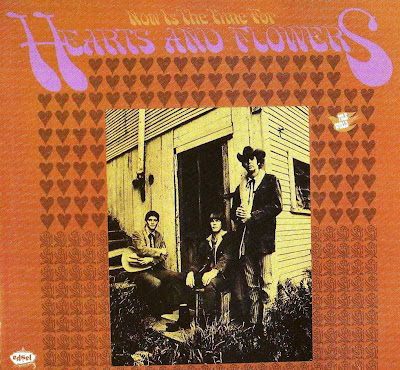
Hearts and Flowers - 1967 - Now is the Time for Hearts and Flowers

Quality: 4.5 out of 5
Trip-O-Meter: 4 out of 5

Hearts and Flowers were a group of musically-inclined time travelers who arrived in 1967 from the futuristic year of 1970 in order to attempt and make the world a groovier place. Yeah, the more likely story is that this So-Cal band was just a touch ahead of its time, but they do so in such strangely specific ways. Sure, the early Byrds and acoustic folk music are pretty obvious influence, but how is it that they seem to channel the sounds of the later Byrds, Crosby, Stills, and Nash, and and late 60's-early 70's L.A. hippy cowboy rock in 1967? I suppose that we'll leave that one to the quantum physicists, and turn our attention to this stellar set of psychedelically-tinged country rock, which comes straight at you dressed in a sonic Nudie suit. A few months ago, I reviewed a few Beachwood Sparks album and noted their clear affinity for the Byrds and Gram Parsons 'cosmic American music,' but now I'm thinking that that band simply had a few Hearts and Flowers tracks stashed away in the more secretive layers of their brains. Hell, as much as I dig Gram Parsons, I think these guys are a better fit for the whole 'cosmic American' thang. It could be their harpsichord that seals the deal.

This plays as a great complete album. None of the tracks are duffers. The folk influences infuse "Try For the Sun" in a purer way that most rock bands tend to muster. "The View From Ward Three" provides us with a country two-step, a quivering fiddle, and a touch of psychedelic guitar in a very groovy mix. Head for "Rock and Roll Gypsies" or "Save Some Time" to hear these guys vocally predict the Crosby, Stills, and Nash blend. "Please" sounds sort of like the Byrds if they were led by Lee Hazelwood, which turns out to be a pretty fine idea if you accept this tune as evidence. While we're on the topic of the Byrds, "I'm A Lonesome Fugitive" would've fit right on their "Sweetheart of the Rodeo," which didn't see release until a year later. While they don't betray their earthy roots, the band save their most psychedelicized blast of sound for the closing "10,000 Sunsets."

I don't know why I've never come across this band until recently. It's a pretty top shelf collection of hazy country rock. They certainly had the game down ahead of some of the A-listeners, and most of these tunes are pretty much in the same league as those more famous folks. I'd definitely be willing to grant this one a 'lost classic' status. There's apparently a second, more psychedelic pop album from a somewhat different line-up of the band as well, although I've yet to hear it.

19 January 2012

Damaged Tape & Andrew Bland - 2012 - Beyond the Ghost House

While we're on the topic of collaboration, here's a new set of recordings that I worked on with Andrew Bland. This is the first time we've shared space on a record since 'Paper Fences' in 2006. From what I understand, Andrew spent 2007-2010 working on his "Field Pictures of Echoes" album (which you'll find at his website http://andrewbland.net/. I took a bunch of bits and pieces that didn't end up on the album and worked them into finished tracks. I sort of assumed that we'd be working with a rustic groove (as you'll hear on his 'Cosmic Relief' album), but I guess that he'd been infected with the synth bug at the time, so I ended up adding a lot of percussion and guitar to the soundscapes in order to get them nice and warm.

I enlisted Scott Atkinson to add a bit of spoken word, and he came up with most of the song titles while flipping through a biography of Chairman Mao. I didn't touch Andrew's track for 'Sailing on the Mekong,' while 'Riptydes of Existence' is actually an outtake from the Damaged Tape album 'Ambiguous Reality.' It didn't make the cut for that one as the completed album was a little too ambient for the tune.

I do hope that you dig spending a little time in our miniature sonic worlds. I welcome any comments and if you're running another blog and like this, I'd be happy for you to repost.

Listen to Me:


Cosmic Relief - 2011

Quality: 4.25 out of 5
Trip-O-Meter: 4.5 out of 5

Here's the latest release from one of my past, present, and likely future collaborators Andrew Bland. His musical trade has basically become creating miniature, instrumental sound paintings and the pallet on this album comes out sounding quite colorful. The instrumentation here is rustic and organic, with a variety of percussion, bass, and electric and acoustic guitars mind-melding with flute and violins. The atmosphere reminds me of the rural cult sound of A Cid Symphony, which I reviewed way back when. Really this one is better - where the A Cid Symphony tends to drone on, Cosmic Relief provides a little more melody and texture.

This music is pretty much meant to meander on in the background in its entirety, but there are a few choice cuts that you may want to explore. "Manic Gaze Rag" does a fine job of occupying the sound of a long-in-decline hippy commune in the Ozarks. Meanwhile, you'll find a groovy, lumbering Crazy Horse with violin epic in "Wetlands." And I'm always up for the percussive, Indo-pulse of "Panorama." Really, you'll find a lot of short 'sound paintings' throughout the length of this set, and different ones will probably strike you in different moods.

I"ll admit that there may be a touch of conflict of interest with reviewing this as the primary artist was my roommate in uni, but I have found this album stuck in my regular listening rotation in the past few weeks. There a very nice variety of sound permeating this album which should interest the sonic mind explorers out there. The music definitely reeks of bohemian weirdness going on behind closed doors, and albums like that tend to get the Doctor's interest. I hope you'll have a groovy journey into this forest of sound.

You'll find me in the downloads section of this website:

11 January 2012

Timothy Leary - 1970 - You Can Be Anyone This Time

Quality: 4.25 out of 4
Trip-O-Meter: 4.5 out of 5

So, realistically Timothy Leary, the Ron Jesus of LSD, probably shouldn't have stretched out into the musical arena, but I'm pretty glad that he did. While his collaboration with Ash Ra Tempel, "Seven Up," is typically pooed upon, it's actually one of my absolute favorite psychedelic albums. This earlier effort isn't as good as that one, but it's still a damn entertaining slab of vinyl. This disc was issued in conjunction with his strange gubernatorial campaign in California against Ronald Reagan. Of course, Leary probably had real business entering that field either, but it's way more entertaining that Donald Trump pretending to run for president. In Leary's words, "The function of government is to get everyone high and feeling good." Of course the truly disturbing parts are when Leary makes sense.

"Live and Let Live" takes up the first side with clips of Leary on the campaign trail backed with a musical jam from Leary's buddies. Fortunately, Leary's buddies consisted on Jimi Hendrix on bass, Stephen Still, John Sebastian, and Buddy Miles. None of them are at the top of their game - I imagine part of the deal was that Leary would keep them heavily 'medicated' - but it's still pretty to hear these guys casually rocking out. And of course if you lend your ears to Leary himself, you'll probably giggle a bit at his political platform, yet dig the words of the man. Side two gives us the title track, which is probably the best thing on the album. A heavily echoed Leary rants on about Hinduism, reincarnation, and the rat race as the music continually shifts - melding R&B jamming with classical Indian music, and a touch of the Beatles and the Floyd, along with some various electronic meddling. "What Do You Turn On When You Turn On" gives Leary a chance to explain his views on astrophysics and brain physiology, I guess. We'll just have to trust the professor on this one. The music simply jams out with tribal percussion, oscillators, and a bit of piano.

I think this album is a wonderful way to let Timothy Leary brainwash you from beyond the grave. Maybe my fellow Americans will even write him in for president in November. North Korea's got a necrocracy, why not us as well? Anyway, this disc will likely put off a fair amount of you, but if you're willing to follow Leary down the rabbit hole, you may dig what you find.

Alan Hull - 1973 - Pipedream

Quality: 3.75 out of 5
Trip-O-Meter: 3.5 out of 5

Hull's solo career sprang forth from Lindisfarne, the English folk-rock band that he fronted. I must admit that I know next to nothing about that band, but the music on "Pipedream" claims some very 1970's which incorporates a bit of folk-rock, a bit of prog, a shot glass of the singer/songwriter vibe and a dash of psych rock. This album doesn't really do anything that's going to knock your socks off, but it's got a few worthy attributes that make a few spins worth your time. The production here is super crisp with that early 70's analog glow. The basic tonal palette here is very groovy. Also raising this disc's stock is Hull's very good songwriting skills, running a nice spectrum from power pop to English folk.

"Pipedream" is a pretty solid listen through and through, but there are definitely a few highlights of note. The disc really gets cranking with "Song For a Windmill," which greatly benefits from a throbbing pulse from some kind of British folk drum. "Blue Murder" tests the waters of the folkier sound of Pink Floyd (best illustrated on their soundtrack for "More"). Hull does a pretty good echo of early power popsters like Badfinger and Big Star with the one-two punch of "Breakfast" and "Just Another Sad Song." As the album progresses, Hull gets even groovier with his folk side, with "Money Game" and "United States of Mind" ranking as the best of a few lightly tripped out acoustic tunes.

Hull's debut solo album is a very pleasant and infectious listen. It's sort of a musical tour of the more creative side of British rock in the early 70's. I don't know if Hull necessarily deserves a spot in the Pantheon of rock (maybe I've got to hear some Lindisfarne before I know that), but he definitely had the cohones to piece together a fine album.